
Speaking to move audiences forward
For more than twenty-five years and on every stage, I hold three steadfast commitments when presenting to an audience: making overlooked people visible, translating ideas and evidence into action, and trusting that change grows from many small acts of advocacy. Each time I share my own experiences and scholarship, I hope to empower my audience to claim the value of their skills and connect pieces of their own journeys.
Speaking & Presentations Artifacts
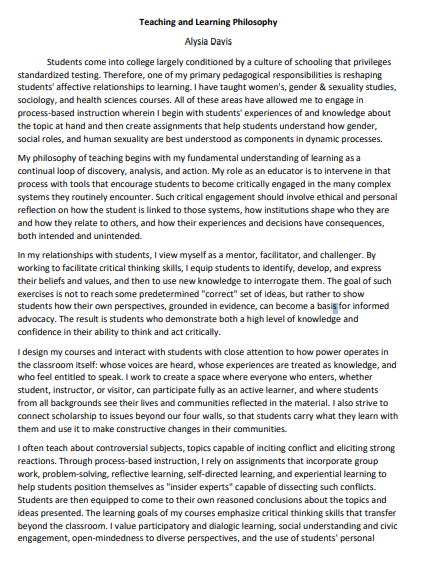
I developed the teaching philosophy statement when I was working as an adjunct instructor and hoping to seek a full-time academic role. It describes my core belief that learning is a continual loop of discovery, analysis, and action. The statement emphasizes my commitment to interdisciplinary inquiry, my practice of ongoing self-reflection, and my responsiveness to student feedback.
Writing this philosophy required me to put into words the beliefs that had largely been implicit in my day-to-day teaching. The thread running through all of my courses is a commitment to helping students see their own experiences as meaningful sources of knowledge. The philosophy statement accurately reflects what students experience in my courses: shared authority, attention to whose perspectives are included, and a genuine openness to explore their experiences.
The principles in this philosophy continue to guide how I work with students. My ePortfolio coaching is a natural extension of my classroom work. I ask questions that help students articulate their values and tell their own stories with confidence. My role as First Lady of Fairmont State University is also informed by this statement. I intend to use the commitments shared in the document to continue to make sure that a wide range of voices on campus are welcomed and heard, and to support efforts to help all students feel they belong and can fully participate in campus life.
Explore Teaching Philosophy
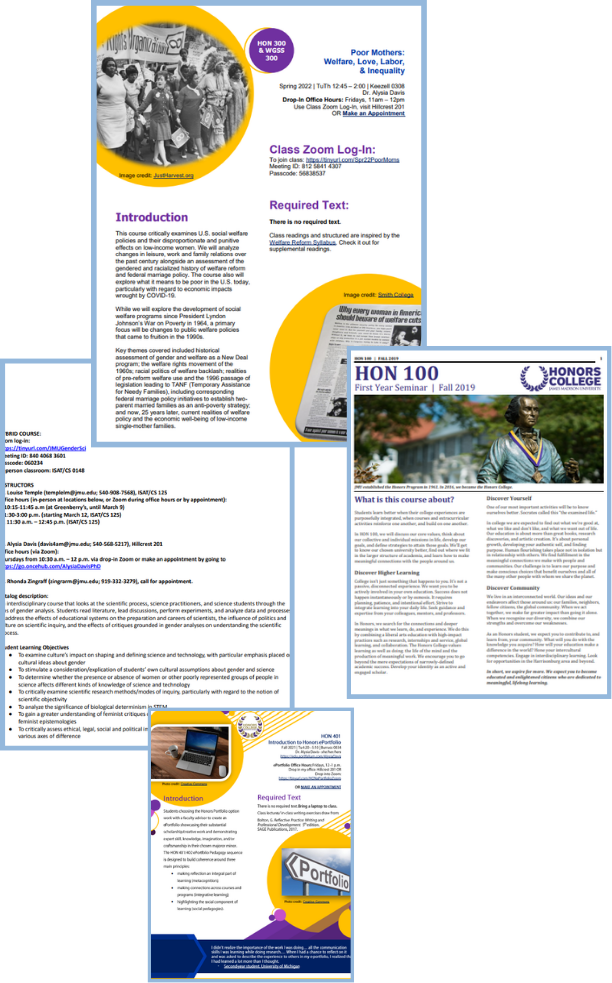
I taught across four very different institutional settings over the course of my academic career: Emory University (R1 private research university), James Madison University (R2 public university), Bridgewater College (small liberal arts college), and Laurel Ridge Community College. My courses ranged from foundational surveys to specialized seminars. I taught in-person and online, both synchronously and asynchronously, and in varying formats, including intensive 4-week summer seminars, seven-week sprints, and full semesters. My most recent teaching appointments were in the James Madison University (JMU) Honors College and in the JMU Department of Interdisciplinary Liberal Studies.
At JMU, my teaching centered on three types of instruction. First, I helped students begin their college careers with purpose. I directed the Teaching Fellows who taught the Honors First Year seminar, a course in which first-year students examined their values, set goals, mapped curricula, and drafted personal statements. Second, I encouraged students to finish with coherence by developing and teaching two courses in the Senior Portfolio Project (SPP) capstone pathway. The courses rested on principles of reflection as metacognition, integrative learning across courses and programs, and the social nature of learning. Third, I asked students to examine systems and institutions critically in seminar classes such as “Poor Mothers: Welfare, Labor, Love, and Inequality” and “Gender Issues in Science.”
My most effective courses gave students real choices, such as which reflection questions to answer, which pathways they wanted to pursue, which artifacts represented them, and even what grade they earned. Those choices were all situated within guiding frameworks of deadlines and rubrics, supporting students while allowing them to take ownership in their learning. My teaching was also inseparable from my work outside the classroom. For example, my years managing volunteer networks and community partnerships directly shaped the volunteer service pathway in the “Poor Mothers” course. My interest in the welfare rights movement began with my master’s thesis. My commitment to debate and civil discourse was evident in course assignments where I asked students to argue a position, actively listen to its opposite, and render a judgment.
The lessons I learned in the classroom now shape my work with Career Portfolio Co. Whether I am working with an individual student, a professional preparing for a career transition, or an institution building an ePortfolio program, I start with the same conviction that guided my teaching: people learn the most when they understand their own learning and can tell their story well.